
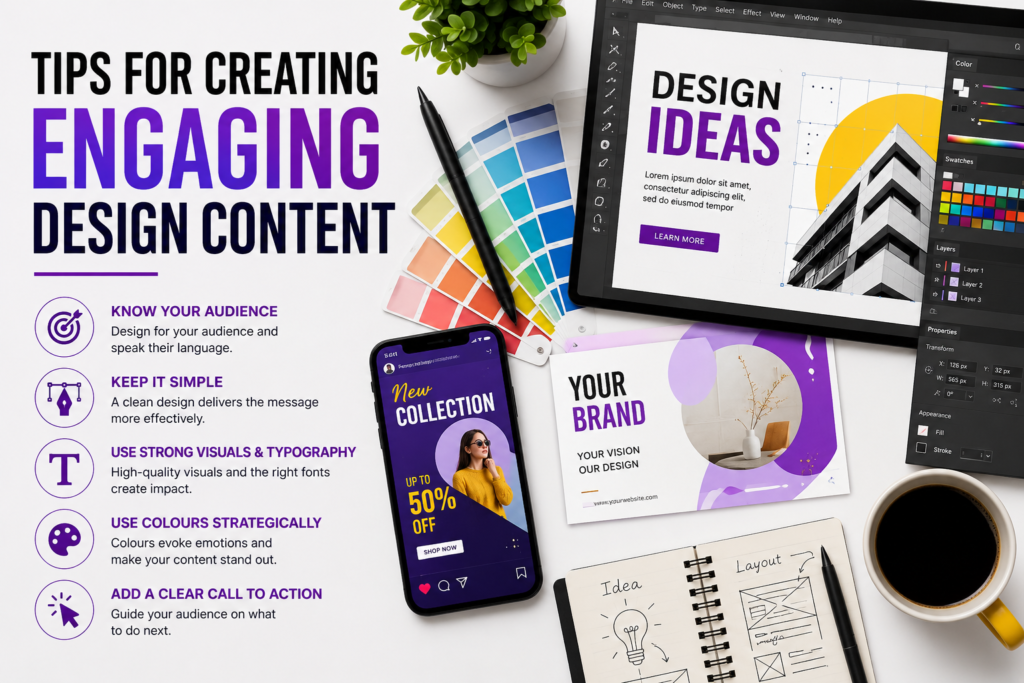
In today’s digital world, visual content plays an important role in how businesses attract attention and communicate with their audiences. Whether it is a social media post, advertisement, website banner, brochure, presentation, or promotional creative, good design can make your message easier to understand and more memorable.
However, engaging design is not simply about using attractive colours, stylish fonts, or impressive images. Effective design combines creativity with strategy. It should communicate the right message to the right audience while maintaining a strong and consistent brand identity.
Here are some important tips for creating design content that captures attention and creates a meaningful connection with your audience.
1. Understand Your Target Audience
Before starting any design project, understand who you are designing for. Your target audience influences your choice of colours, typography, imagery, layout, and overall visual style.
A design created for a young audience may have a completely different look from one created for a professional corporate audience. Understanding your audience helps ensure that your design feels relevant and relatable.
Ask yourself: Who will see this design? What do they need? What kind of visual style will attract their attention?
2. Start With a Clear Objective
Every design should have a purpose. Before creating a creative, identify what you want the audience to understand or do.
Your goal could be to:
- Promote a product
- Build brand awareness
- Generate leads
- Announce an event
- Share information
- Increase engagement
- Drive website visits
When the objective is clear, it becomes easier to decide which visual elements should be included and which should be removed.
3. Keep the Design Simple
One of the most common design mistakes is trying to include too much information in one creative.
A cluttered design can confuse viewers and make the main message difficult to understand. Instead, focus on one primary message and organise supporting information around it.
Use sufficient spacing, clear sections, and a balanced layout. Remember that simplicity does not mean boring. A simple design can be powerful when every element has a purpose.
4. Use Strong and Relevant Visuals
Images are often the first element people notice. High-quality photographs, illustrations, icons, graphics, and other visual elements can make your content more engaging.
However, visuals should always support the message. Avoid using images simply because they look attractive.
Choose visuals that communicate your product, service, idea, or brand personality. Relevant imagery makes the design more meaningful and easier to understand.
5. Choose Typography Carefully
Typography is one of the most important parts of graphic design. The right fonts can improve readability and communicate your brand personality.
Use fonts that are easy to read and create a clear hierarchy between headings, subheadings, and supporting text.
Avoid using too many different fonts in a single design. A combination of two or three complementary typefaces is often enough to create a professional visual structure.
6. Use Colours Strategically
Colour can influence attention, emotion, and perception. A strong colour palette can make your design more attractive while reinforcing your brand identity.
Choose colours that match your brand personality and create sufficient contrast between important elements.
For example, a CTA should be visually noticeable, while background colours should not make the main text difficult to read.
Most importantly, maintain consistency with your brand’s existing colour palette.
7. Create a Strong Visual Hierarchy
Visual hierarchy tells viewers where to look first, second, and third.
You can create hierarchy through:
- Font size
- Font weight
- Colour
- Contrast
- Spacing
- Position
- Image size
Your most important message should receive the strongest visual emphasis. Supporting information can then be presented at a smaller scale.
A clear hierarchy allows viewers to understand your design quickly.
8. Maintain Brand Consistency
Consistency helps people recognise your business across different platforms.
Your social media creatives, website graphics, advertisements, brochures, and presentations should share common visual elements such as colours, typography, logo usage, imagery, and design style.
A consistent identity makes your business look more professional and helps build familiarity with your audience.
9. Design for the Platform
Every platform has different requirements and viewing behaviours.
A design for Instagram may need a different layout from a LinkedIn graphic, website banner, printed brochure, or mobile advertisement.
Always consider the platform, dimensions, screen size, readability, and user behaviour before creating the final design.
A design that looks good on a desktop may not work effectively on a mobile screen.
10. Add a Clear Call to Action
If your design is intended to encourage an action, make that action clear.
Examples include:
Learn More | Contact Us | Get Started | Shop Now | Book Today | Explore Services
A clear call to action helps guide the audience toward the next step.
The CTA should be noticeable without overpowering the main message.
11. Use Design to Tell a Story
Great design can communicate a story without requiring large amounts of text.
Use images, layouts, colours, illustrations, and typography to create a visual journey.
For example, a campaign can introduce a problem, present the solution, highlight benefits, and finish with a call to action.
Visual storytelling can make content more interesting and help audiences connect with the message.
12. Focus on Quality and Details
Small details can have a big impact on the overall appearance of a design.
Check alignment, spacing, typography, image quality, colour consistency, spelling, and proportions before publishing.
Professional design is often recognised through these details. A well-finished creative communicates care and attention to quality.
13. Test and Improve Your Designs
Design should not always be treated as a one-time process. Different audiences may respond differently to visual styles.
If you are creating digital marketing content, monitor engagement and performance to understand what works best.
You can experiment with different layouts, headlines, images, colours, and creative approaches while maintaining your core brand identity.
Using performance insights can help you continuously improve your design strategy.
How Professional Design Can Strengthen Your Brand
Engaging design content can help businesses communicate more effectively and create a stronger visual identity. Professional design brings together creativity, strategy, branding, and audience understanding to create visuals that have a clear purpose.
A professional designer does more than select colours and fonts. They consider the business objective, target audience, brand personality, platform, message, and user experience.
From social media creatives and advertising graphics to logo design, brand identity, UI/UX, brochures, presentations, and marketing materials, every design can contribute to the way customers experience your brand.
Strong design can help you:
- Capture attention
- Communicate messages clearly
- Build brand recognition
- Improve audience engagement
- Create a professional image
- Stand out from competitors
- Strengthen customer connections
The key is to avoid following trends simply because they are popular. Your design should always support your brand and business goals.
Final Thoughts
Creating engaging design content requires more than creativity. It requires strategy, clarity, consistency, and a strong understanding of your audience.
When your visuals are purposeful and professionally designed, they can do more than look attractive. They can communicate your message, strengthen your identity, encourage action, and help your business stand out.
Design with purpose. Create with creativity. Connect with your audience.